- Be aware of what you and your partner want for yourselves and what you want from the relationship.
- Let one another know what your needs are.
- Realize that your partner will not be able to meet all your needs. Some of these needs will have to be met outside of the relationship.
- Be willing to negotiate and compromise on the things you want from one another.
- Do not demand that a partner change to meet all your expectations. Work to accept the differences between your ideal mate and the real person you are dating.
- Try to see things from the other's point of view. This doesn't mean that you must agree with one another all the time, but rather that both of you can understand and respect each other's differences, points of view, and separate needs.
- Where critical differences do exist in your expectations, needs, or opinions, try to work honestly and sincerely to negotiate. Seek professional help early rather than waiting until the situation becomes critical.
- Do your best to treat your partner in a way that says, "I love you and trust you, and I want to work this out."
Sunday, 20 November 2011
Eight Basic Steps to Maintaining a Good Relationship

The Poor African Diet
 |
| Balanced diet |
The poor diet that most African children are exposed to is one of the main causes of African poverty and underdevelopment. It could perhaps explain why it was easy for Europeans to colonise Africans and why Africa is still being exploited both by foreigners and by its own leaders. The brain is the intelligent part of the body. The highest function of life- thinking- takes place in the brain. Why are Kenyans and by extension Africans corrupt? Poverty. Poverty stems from lack of a balanced diet and as a result, poor or bad brain development. To conceive and execute good strategies, one requires good working brains. Good brains in turn need good food.
Consider the most recommended diet below:
Carbohydrates 50-60%
Protein 10-20%
Fats 30-35%
Fibres 25-35grammes/daily
Vitamins
Carbohydrates are a source of energy. Proteins ensure body growth and repair (remember brain growth and worn out cells also need replacements). Fats provide energy and fat soluble vitamins. Vitamins in small quantities keep you healthy. Mineral salts ensure healthy teeth, bones and muscles while Fibres help your intestines to function correctly
Most African children and adults do consume 90% of carbohydrates in their daily diet and about 10% of the rest. The most important source of protein to an African’s brain comes from the carbohydrates metabolism already in the body. This metabolism tries hard to change the too much consumed carbohydrates to protein. A growing human being and developing brains need a lot of protein. Proteins are very important for the repair of worn out or dead cells. This is seen even in hospitals after operations; a poor diet causes wound to heal slowly and poorly. Immunity, the way a body fights germs or diseases is also weak on individuals having poor diet. No brain will function well if you do not have enough food or good proteins.
Africans always blame the whites for malpractices that exist on the continent- while most of them are a result of our poor thinking. Consider the Anglo-leasing or Goldenberg scandals in Kenya. Europeans as well as respective African leaders were involved. But who is suffering? We see a very big difference on brain manipulations. Whereas Kenyan leaders were manipulating the system in Kenya and the tax-payers, the Europeans or Americans connected in these scandals were manipulating both our leaders and the common Kenyan man and woman plus their children.
You can extend that to the skewed global economic order that has made Africans producers of raw materials but left the processing of finished products to developed nations. We can’t harness our mineral resources; exploit solar energy; feed ourselves or even believe in ourselves unless a white man is involved! Isn’t that a show of malfunctioning or underdeveloped brains?
The past generation and present adults in Africa are already a let down to the continent. Just look at Gaddafi; how can a president call for a jihad war against a foreign country as Gaddafi is doing now to Switzerland- just because his son messed in Switzerland and was subjected to the Swiss law? Do you think he has any live brainy cells left in his head? What development will such a brain will bring to Africa? What development will brains that collude with foreigners to plunder Africa’s resources bring to the continent?
The poor diet theory explains a lot about the less achievement Africans have accomplished. The gene theory that laziness or brainless is more on blacks than in other races does not hold water anymore today.
We need to give our children better diets. We will see the difference. We need good diets- this will ensure good brains hence good mentors and good programmes. Most of Africans still eat a diet of 90% carbohydrates and 10% of very useless overcooked vegetables. This diet contains little or no nutrients required by the human brain to develop fully in order to handle due process. Our carbohydrate dependent society combined with leaders who are a product of carbohydrates is a recipe for disaster. Just visit any boarding school in Africa and consider its diet, then compare it with our European counterparts.
If the brain is already saturated with a lot of carbohydrates, do you expect to get any inventors? You will end up breeding more corrupt bookworms and 'proffessionals' who can't solve any problem in the society.
Tuesday, 18 October 2011
Could you have a heart attack -- and not know it?
The lights dim in your favorite movie theater. You have your popcorn, Goobers and the largest soda you've ever seen. You're ready to watch the hero battle corruption for the good of all mankind -- to risk it all and lose his one true love in the process. He overcomes the odds and defeats the unscrupulous enemy. Alone and exhausted, his true love returns to reclaim the man that she cannot live without. Suddenly, our hero clutches his chest, doubles over and has trouble breathing. He drops to his knees and lays in his lover's arms. Before he goes, he manages a final farewell -- "I did it all for you." Then his tired, broken heart gives out once and for all. The curtain falls -- not a dry eye in the house.
If only all heart attacks were like they are in the movies. Unfortunately, that's not how they typically go down. A heart attack isn't very complicated. Your heart, like all muscles, needs blood to function properly. Blood is carried throughout the body through blood vessels and larger arteries. When the coronary arteries that supply blood to your heart get blocked, you're likely to have a heart attack. These arteries become blocked because of a buildup of something called plaque. Plaque may build if:
Some of the common symptoms of a heart attack are:
If only all heart attacks were like they are in the movies. Unfortunately, that's not how they typically go down. A heart attack isn't very complicated. Your heart, like all muscles, needs blood to function properly. Blood is carried throughout the body through blood vessels and larger arteries. When the coronary arteries that supply blood to your heart get blocked, you're likely to have a heart attack. These arteries become blocked because of a buildup of something called plaque. Plaque may build if:
- you're overweight
- you don't exercise
- your diet has too much fat and cholesterol
- you're stressed
- you smoke
- you drink alcohol in excess
- you have a history of heart disease in your family
Some of the common symptoms of a heart attack are:
- sweating
- shortness of breath
- chest pressure
- chest pain
- prolonged squeezing in your chest area
- pain shooting through arms, shoulders, back or jaw
- nausea and vomiting
Tips on How to Have a Healthy Heart, How to Prevent Heart Disease.
If an apple a day keeps the doctor away, what would it take to avoid a heart surgeon? How about a multivitamin / mineral pill and some omega-3 oil (canola-rapeseed, flax, fish)? Add a diet low in processed food and a good 'lifestyle' (don't smoke, control waist size, manage stress well, some exercise) and you will improve general health and help prevent heart disease. I know, it is normal to believe you're eating a good diet but there is mathematical certainty that even the best diet does not get you the vitamin levels that our bodies and genome developed on. Supplementation fixes this and is safe, cheap and, best of all: easy.  This site looks at the food, supplement and prevention side of disease. I study nutrition in medicine as an independent researcher but it is not my job. This site doesn't generate money or sell anything. Below are highlights about the nutrients that prevent damage to your artery and bone structure and sometimes even cure it, and about those that can help you survive already existing artery damage.
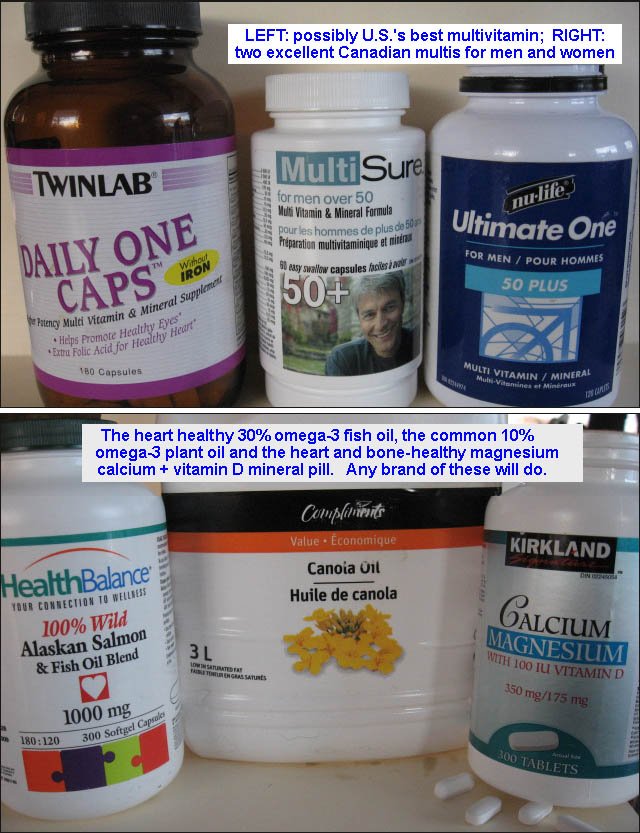 This site looks at the food, supplement and prevention side of disease. I study nutrition in medicine as an independent researcher but it is not my job. This site doesn't generate money or sell anything. Below are highlights about the nutrients that prevent damage to your artery and bone structure and sometimes even cure it, and about those that can help you survive already existing artery damage.
In food processing, as when making flour or noodles, we lose 60-90% of most heart healthy vitamins. We degrade proteins by frying and high heat and our factories hydrogenate oil which first zaps all omega-3 (really vitamin F-3) by trans-forming it into toxic trans fat. Science shows that a heart healthy diet is one with relatively unprocessed foods with veggies and some fruits, and rice or grains that retain some of their original kernel-structure to slow digestion. Such 'whole' foods became scarce in Western diets. If you can't recognize part of the original food, the item is processed or refined. Some eggs, liver or fish are probably also vital for most of us.

Why a add multi-vitamin pill to your diet? Well, most fast single nutrient diseases like scurvy, beriberi and goiter were wiped out by food fortification, our 'weapon of mass nutrition'. However, processed foods low in many nutrients such as vitamins B6, B12, folic acid and others, cause 'Long-Latency Deficiency Diseases', such as heart disease, cancer, bone loss and Alzheimer's. Think of these as nutrient deficiency diseases with long incubation periods and the science suddenly makes sense! Start with cholesterol and the science will never makes sense (can your doctor explain the 6th figure from the bottom?).
Wednesday, 12 October 2011
Long Distance Relationship Arrangements
OK, so you know that many long distance couples find this arrangement to be the best of both worlds. You can live life without constant attention to a partner's needs, but have a person with whom you connect for romance and fun.
But what happens if something comes up in your normal life that is a real crisis? How does your long distance boyfriend or girlfriend fit into this situation? Do you not tell them about it? This may be the choice for some who don't want to bring “real life” into the bubble of that long distance love.
Or do you call them for support? Do you reach out as most folks would, for the comforting voice of your intimate partner?
There is no correct answer here. But it can be a turning point in telling you both about where your relationship is and where it is going.
How each of you handle this situation will tell you a lot. How do they handle your crisis. Or, conversely, how do you feel about them bringing their crisis to you? If you share a crisis with them, are they supportive or avoidant? If they call you, are you empathic or resentful that they're dumping this on you? A positive response can range from their staying more in touch than normal by calling or emailing regularly to get you through the crisis. Or it could involve their hopping on a plane to be with you. Or it could be anything in between. There's no correct response in this situation. It's all about what each of you needs, how well that need is conveyed, and how the response comes back. How it's handled will tell you a lot about what's possible for a real relationship down the road.
But what happens if something comes up in your normal life that is a real crisis? How does your long distance boyfriend or girlfriend fit into this situation? Do you not tell them about it? This may be the choice for some who don't want to bring “real life” into the bubble of that long distance love.
Or do you call them for support? Do you reach out as most folks would, for the comforting voice of your intimate partner?
There is no correct answer here. But it can be a turning point in telling you both about where your relationship is and where it is going.
How each of you handle this situation will tell you a lot. How do they handle your crisis. Or, conversely, how do you feel about them bringing their crisis to you? If you share a crisis with them, are they supportive or avoidant? If they call you, are you empathic or resentful that they're dumping this on you? A positive response can range from their staying more in touch than normal by calling or emailing regularly to get you through the crisis. Or it could involve their hopping on a plane to be with you. Or it could be anything in between. There's no correct response in this situation. It's all about what each of you needs, how well that need is conveyed, and how the response comes back. How it's handled will tell you a lot about what's possible for a real relationship down the road.
Solve Conflicts in Relationships
Solve Conflicts by taking the LEAD
Conflict is not in and of itself a bad thing. In fact, conflicts in relationships can be constructive when used as a vehicle for improving communication. The following four steps can help you use conflict as a tool for gaining clarity, creating deeper understanding and strengthening relationships.
When you are in the midst of conflict, take the LEAD to manage it respectfully and calmly.
Listen to what is being said. Many times, conflict arises from a simple lack of understanding or miscommunication. Avoid making assumptions about what you hear. Instead, ask for clarification. For example, “I heard you say X, is that what you meant?”
E xplorethe feelings that come up – Sometimes conflict escalates because something about the situation is an emotional trigger for us. If you’re feeling upset by the conversation, try to determine where the feeling is coming from. Take several deep breaths and try to remember that what is happening now is completely separate from the past. You can manage conflict more effectively if you deal only with the matter at hand. When you start introducing memories and past sleights it will be tough to get past the history of bad feelings to work toward a positive outcome.
A ffirm theother person’s point of view. You don’t have to agree to understand the other point of view. Simply acknowledging and validating someone’s feelings can be a powerful tool for resolving conflict positively. At the end of the day, most people just want to be heard.
Decide on a fair course of action. Now that you have a clear idea of what the problem is and where the person is coming from, it is time to explore some solutions. Throw out some ideas that you can vet together. Choose the soundest option that you can agree on. Plan to revisit your decision within a specified period of time to see how you are doing and what changes, if any, need to be made.
Conflict is not in and of itself a bad thing. In fact, conflicts in relationships can be constructive when used as a vehicle for improving communication. The following four steps can help you use conflict as a tool for gaining clarity, creating deeper understanding and strengthening relationships.
When you are in the midst of conflict, take the LEAD to manage it respectfully and calmly.
Listen to what is being said. Many times, conflict arises from a simple lack of understanding or miscommunication. Avoid making assumptions about what you hear. Instead, ask for clarification. For example, “I heard you say X, is that what you meant?”
E xplorethe feelings that come up – Sometimes conflict escalates because something about the situation is an emotional trigger for us. If you’re feeling upset by the conversation, try to determine where the feeling is coming from. Take several deep breaths and try to remember that what is happening now is completely separate from the past. You can manage conflict more effectively if you deal only with the matter at hand. When you start introducing memories and past sleights it will be tough to get past the history of bad feelings to work toward a positive outcome.
A ffirm theother person’s point of view. You don’t have to agree to understand the other point of view. Simply acknowledging and validating someone’s feelings can be a powerful tool for resolving conflict positively. At the end of the day, most people just want to be heard.
Decide on a fair course of action. Now that you have a clear idea of what the problem is and where the person is coming from, it is time to explore some solutions. Throw out some ideas that you can vet together. Choose the soundest option that you can agree on. Plan to revisit your decision within a specified period of time to see how you are doing and what changes, if any, need to be made.
Saturday, 1 October 2011
Multi-Vitamin Supplementation
Like Hannah Green said,Health is not simply the absence of sickness!
Many people don't really know their body's requirements and
Many people don't really know their body's requirements and
why there is a need for supplementation every single day.
They completely rely on their meals alone, thinking these will suffice?
Multivitamins intake has been a debatable topic over the years,
Multivitamins intake has been a debatable topic over the years,
to date, there is not enough of awareness.Complacency still
exists in the community. Many are complacent that by having
the standard recommended servings of vegetables and fruits,
taking multivitamins or supplements is not necessary.
But the truth is multivitamins are essential. You do not have to
But the truth is multivitamins are essential. You do not have to
wait till you are unwell to consider taking them.
Vitamins are for supplementing a normal meal with nutritional
values that food cannot give. We need to replenish ourselves
with vitamins constantly because they are not stored for long in the body.
Instead, they travel through your bloodstream. This cluster of
vitamins includes vitamin C, and the large group of B vitamins - B1 (thiamine),
B2 (riboflavin), niacin, B6 (pyridoxine), folic acid, B12 (cobalamine),
biotin, and pantothenic acid.
Herbal supplements are another nutritional enhancement.
Herbal supplements are another nutritional enhancement.
They are processed plants in capsule form. Herbal supplements
have phytonutrients that exert different activities in the body to
enhance biological processes. The big difference between vitamins
and herbal supplements is that the latter may be used to alleviate
symptoms of specific ailments or diseases. For example,
Ashwagandha is widely used to help relieve stress while restoring
balance in your nervous system. It improves the fighting capacity
or adaptability of the body against all types of stress. Ashwagandha
also deeply rejuvenates on a cellular level. It elevates stamina and
endurance, maintaining enough energy throughout the day as
it relieves exhaustion. Vitamins and mineral supplements are
taken generally to make up for nutrients lacking in their diet.
Women, who are not getting sufficient calcium diet, take calcium
supplements daily to help prevent osteoporosis.
We may not realize this, but by consuming herbal supplements,
We may not realize this, but by consuming herbal supplements,
we are absorbing nutrients from plants.
Herbal medicine has come a long way and holds a respected history.
Numerous studies have proven for a fact that the therapeutic
benefits and the healing ability of several medicinal herbs are
significant if they are properly administered with a healthy lifestyle.
Subscribe to:
Posts (Atom)